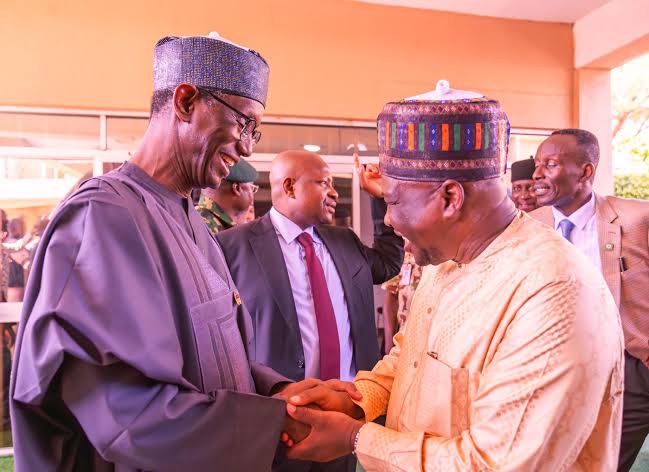

Fintiri’s purported APC defection: A deft political move or suicide mission?
By Yauba Sarkin Yakin Jagaban
The reported plan by Governor Ahmadu Umaru Fintiri to defect from the Peoples Democratic Party (PDP) to the All Progressives Congress (APC) has triggered intense debate across Adamawa State’s political landscape. While some see the strategy as a bold move to recalibrate his political preferences and interests ahead of 2027, others describe it as a high-risk gamble that could ultimately annihilate his remaining political capital.
Critics argue that defection without an established structure is a perilous undertaking in Nigerian politics. Political relevance, they insist, is not built on titles or incumbency alone but on tangible grassroots machinery from ward leaders, polling unit canvassers, and loyal foot soldiers capable of mobilizing votes. They noted that based on his selfish demeanor, Fintiri has lost this important support base.
Related news
Fintiri and the exigency of a compelling political shift
Kwacham predicts Adamawa APC’s implosion over Fintiri’s touted defection
Hong warns against leadership takeover in Adamawa APC, urges Tinubu to ensure justice
It is therefore apt to say that without a coherent and clear structure moving with him, Fintiri risks entering the APC not as a formidable bloc leader but as an isolated figure seeking accommodation.
In Adamawa, the APC is not an empty shell or disjointed political platform awaiting new leadership. It is already populated by influential figures and entrenched power blocs with years of organizational investment and loyal followership.
Among the prominent personalities associated with the party are former Governor Murtala Nyako, former presidential candidate and Nigeria’s NSA Nuhu Ribadu, former military administrator Buba Marwa, and former Foreign Affairs Minister Idi Hong, among several others.
These are not passive actors. They are longstanding stakeholders with established networks and influence across local governments and wards.
The central question, therefore, is whether Fintiri would enter the APC as a consensus leader or as a late entrant negotiating for space within a pre-existing hierarchy. Political history suggests that newcomers rarely displace entrenched structures without overwhelming grassroots backing.
The introduction of direct primaries further complicates the calculus. With the APC mandating that candidates emerge through a process involving registered party members rather than selected delegates, the emphasis shifts squarely to numbers. In such a system, internal deals and elite bargaining hold less sway. What matters most is the size and loyalty of one’s base within the party’s membership register.
APC sources claim the party commands hundreds of thousands of registered members in Adamawa, many already aligned with established factions. If this is accurate, a late entrant would need to mobilize significant numbers to remain competitive in internal contests. The absence of such numerical strength could relegate any new bloc to minority status within party decision-making structures.
Another concern frequently raised is the risk of alienating an existing support base without securing a new one. Political transitions can create perceptions of displacement among loyalists who feel ideologically, strategically, or even culturally out of place in a new environment.
Should key segments of Fintiri’s support base migrate to alternative platforms such as the Social Democratic Party (SDP) or the African Democratic Congress (ADC), his influence could diminish substantially.
Trust also looms large in coalition politics. Political alliances are sustained by a reputation for reliability and respect for agreements. Where a perception of inconsistency or abrupt realignment takes root, potential allies may become cautious. In multi-bloc party systems like the APC, trust functions as political currency. Without it, even numerical strength can struggle to translate into enduring influence.
One particularly contentious element of the unfolding scenario is the proposed use of a registration drive to demonstrate grassroots backing.
Supporters of the governor suggest that opening a special portal or mobilizing fresh enrollees into the APC could validate his strength. However, critics describe this as a public test of political relevance.
A strong turnout, potentially in the hundreds of thousands, could signal negotiating power. Conversely, modest figures might reinforce narratives of structural weakness.
Observers frame this as the “50,000 question”: if fewer than 50,000 loyalists follow him into the APC, what would that signify? In democratic systems, minority voices are heard, but majorities determine outcomes. Without commanding numbers, a political bloc’s bargaining power declines, and internal resistance becomes more likely. In such circumstances, the party structure shapes the entrant rather than the entrant reshaping the party.
Supporters of the governor, however, may argue that political realignments often involve calculated risks and that incumbency still carries weight in shaping alliances. They could also point to the fluid nature of Nigerian politics, where today’s adversaries can become tomorrow’s allies under new strategic imperatives.
Nevertheless, detractors maintain that defecting without guaranteed mass movement, clear control over party structure, or strategic advantage under direct primaries exposes any politician to significant vulnerability. They question whether the path ahead offers a realistic route to dominance or merely a struggle for accommodation within a system already consolidated by others.
At its core, the debate reflects broader anxieties about political survival, succession planning, and power configuration in Adamawa State.
Whether Governor Fintiri’s anticipated move to the APC will be remembered as a masterstroke or a miscalculation remains uncertain. What is clear, however, is that the decision carries profound implications not only for his personal political future but also for the balance of forces within the state’s evolving party landscape.
As one commentator succinctly put it, political realignment can either be an act of strategic repositioning, or a step toward irreversible political perdition. The coming months will reveal which path this defection ultimately represents.
Yauba writes from Kaduna.