Dougirei secondary school: An eyesore sharing space with Adamawa govt house
By Mohammed Ismail
Just at the backyard of the seat of power in Yola, students sit on bare floors, teachers sit on mats, toilets remain locked for lack of water, while classrooms threatened by flooding and erosion struggle to remain standing. This is the tale of Dougirei secondary school, an education institution operating within the vicinity of Adamawa seat of power.
From the imposing Adamawa State Government House, where decisions affecting the lives of millions are made, the school approximates to the sore epitaph of government’s lip service and total neglect of the important educational sector.
A visit to the Dougirei Secondary School by a group of journalists from correspondents’ chapel unveils the harsh reality about the neglect schools in the state are facing.
Also read
Despite OGP buy-in, Adamawa govt fails major financial integrity test
Adamawa’s huge debt elicits furore amidst rising allocations
Growing anxiety as Adamawa retirees await Fintiri’s N8bn pension-fest
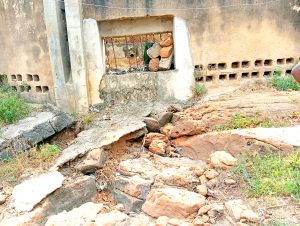
The promise of good education by the state is falling apart by the harsh reality of broken classrooms, inadequate furniture, dearth of water, insufficient teachers and a frightening lack of basic learning facilities.
It is a disturbing contrast. While the school shares a boundary with the seat of government and sits in one of Yola’s high-end neighbourhoods, its students and teachers mostly from vulnerable households in Yola, are struggling to learn and work in conditions that should have no place in a modern public school.
For the more than 1,000 students enrolled in the junior and senior secondary sections, going to school which should be in itself an exciting experience is associated with fears and phobia due to the uncertainty of the certain risks and hazards involved in attending a school with inclement environment and substandard facilities.
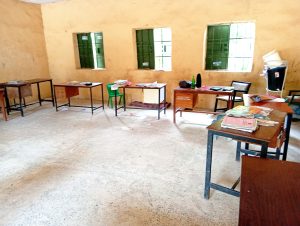
For the students, coming to school is associated by the daily realities of finding safe spaces to sit, enduring leaking roofs during rainy season and coping with an environment that increasingly threatens their safety.
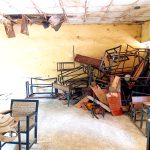
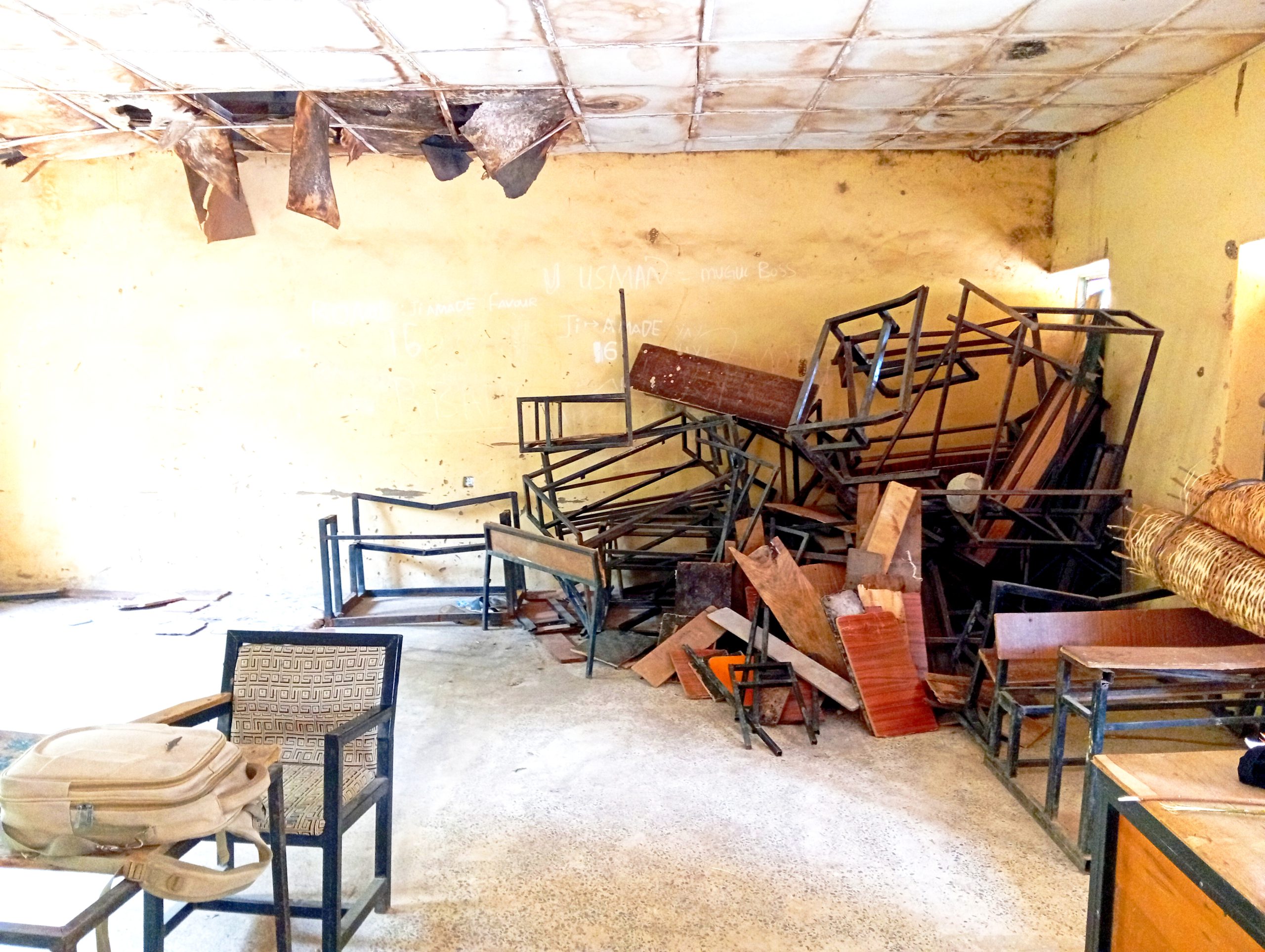
The visit, early this week revealed a school in distress. In some classrooms, students sit on bare floors, window ledges and makeshift seats fashioned from broken blocks. Desks and chairs are either inadequate or damaged beyond use.
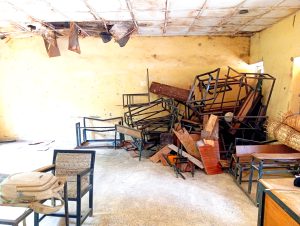
Some teachers have reportedly resorted to bringing personal mats to school to create makeshift seats and working surfaces.
The staff room, which serves teachers from both the junior and senior secondary sections, is also too small to accommodate the personnel comfortably. During the visit, some teachers were seen sitting under trees because of the dearth of seats in the staff room and excessive heat.
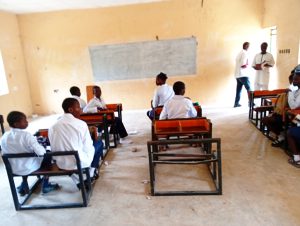
The classrooms present an even more troubling picture. Their ceilings are broken and falling leaving openings that could provide sanctuary for dangerous reptiles. The roofs are worn out, with leakages becoming particularly severe during the rainy season further exposing students and teachers to unnecessary hazards.
For students expected to concentrate on their studies, the fear of the unknown is a major inhibition.
Despite being located close to the headquarters of the Adamawa State Water Board, Dougirei Secondary School has no functional water supply. The absence of water has rendered its toilet facilities unusable, forcing students to seek nearby bushes whenever nature calls.
The situation raises serious concerns about sanitation, personal safety and the dignity of the children, particularly female students and the exposure to the vagaries of dangerous reptiles abounds in the area.
The school also has no examination hall. Consequently, students sitting external examinations, including the West African Senior School Certificate Examination and National Examinations Council examinations, are compelled to write their papers under trees.
For candidates preparing for examinations that could determine their academic future, such an arrangement is hardly conducive to concentration or good performance.
The absence of a science laboratory further compounds the challenges. Although the school offers science subjects, students have no laboratory where they can conduct practical lessons and acquire the hands-on knowledge required by the curriculum.
Some teachers, who spoke on condition of anonymity, blamed the lack of laboratory facilities for the failure of students in science-related subjects.
They also lamented the shortage of teaching personnel. With only 24 teachers reportedly serving a population of more than 1,000 students, the burden on the available staff is considerable.
One teacher questioned how a school located directly behind the Government House could be left in such a condition while the state government continues to declare education a priority.
Perhaps the most frightening aspect of the school’s predicament is the flooding that occurs during the rainy season. The school reportedly receives large volumes of water discharged through drainage pipes from the Government House.
Whenever heavy rainfall occurs, the water flows into the school premises with considerable force, disrupting academic activities and putting the lives of students and teachers at risk.
The construction of a waterway from the Government House into the school has reportedly worsened the situation, exposing the premises to flooding and increasing the threat of erosion.
Some classrooms are said to be under serious strain from the continuous flow of water, raising fears that parts of the structures could collapse if urgent intervention is not undertaken before the next rainy season.
The school management has reportedly suspended academic activities on some occasions during periods of heavy rainfall to protect students from the floodwaters.
The danger became more apparent as one of the visiting journalists’ missed his step and fell to the ground while negotiating the rough and uneven terrain within the school premises.
If an adult visitor could suffer such an accident, the risks confronting hundreds of schoolchildren who use the premises daily are even more concerning.
The school is also facing the threat of being gradually consumed by gully erosion, adding another layer of uncertainty to its future as a result of the storm water usually released from government house following the construction of some edifices in the seat of power without recourse to environmental impact assessment.
For parents, teachers and the students, the situation has become a source of real danger, frustration and helplessness.
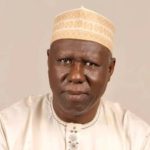
The Chairman of the Parents-Teachers Association, Alhaji Mohammed Usman, said he had written several letters to the Ministry of Education to draw attention to the school’s deteriorating condition, but without any satisfactory response.
His frustration was evident as he described repeated attempts to secure government intervention that had yielded little result.
“I’m tired of writing letters because the ministry is not concerned about the plight of our students and teachers. We are now waiting for God’s intervention, not man’s intervention again,” Usman said.
His words capture the desperation of parents who send their children to school expecting a safe environment and a reasonable opportunity to learn, only to see them confronted with conditions that threaten both their education and wellbeing.
The condition of Dougirei Secondary School has also raised questions about the implementation of the education policy of Governor Ahmadu Fintiri’s administration.
The government has repeatedly identified education as a priority, introducing free education and school feeding programmes in boarding schools. It has also announced plans to establish model secondary schools across the state’s 21 local government areas.
However, the experience of students at Dougirei raises a difficult question: what happens to children attending existing public schools that are yet to enjoy basic facilities?
A review of Adamawa State budget figures indicated that the government allocated N17.32bn to education in 2020, N24bn in 2021, N17.3bn in 2022, N26.8bn in 2023, N15.603bn in 2024, N40.41bn in 2025 and N40.63bn in 2026.
These allocations have heightened calls for transparency and accountability in the management of education funds, particularly regarding the provision of basic infrastructure in public schools.
Last year, this paper has in an FOI request asked the state government to reveal how it spent the tax payers monies on critical projects without results.
As at the time of writing this report this paper could not get official response from the government. A visit by the journalists to the office of the Commissioner for Education, Dr Umar Pella, on Tuesday did not yield results because the commissioner was not on seat at the time of the visit. Telephone calls to him by one of the visiting journalists were also unanswered, and he was yet to return the calls as of the time of filing this report.
For the children of Dougirei Secondary School, however, the government’s claim of prioritising education is not matched by action punctuated by the daily realities of the school’s habitation.