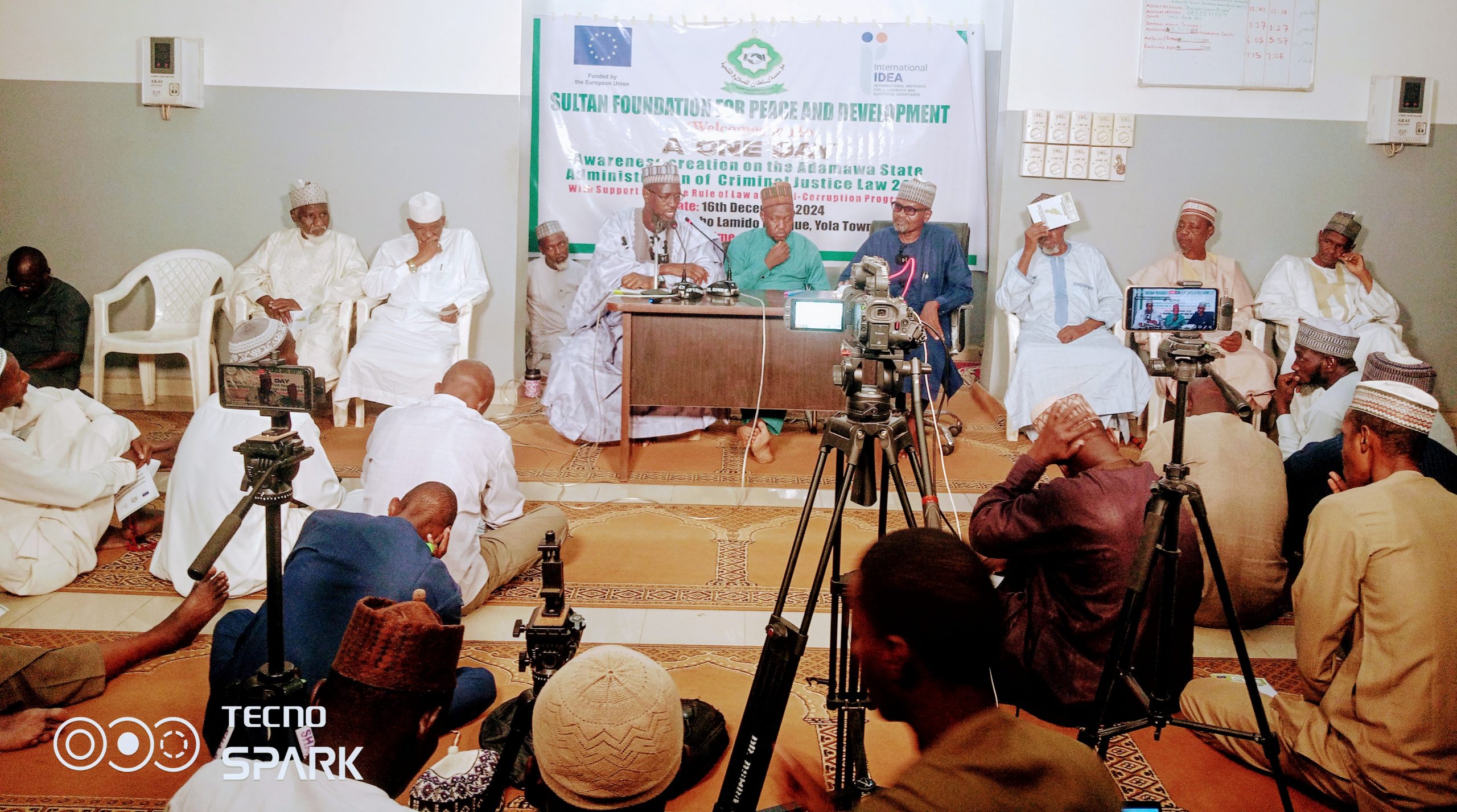
ACJL: Sultan Foundation raises awareness at Modibbo mosque in Adamawa
As part of its ongoing efforts to educate communities about the Administration of Criminal Justice Law (ACJL) in Adamawa State, the Sultan Foundation for Peace and Development held a one-day sensitization program at the Late Modibbo Mosque in Yola on Monday. The event, supported by the European Union-funded Rule of Law and Anti-Corruption Programme (RoLAC), aimed to highlight the law’s innovative provisions and their significance in reforming criminal justice processes.
The ACJL, enacted in Adamawa State on December 10, 2018, was designed to address gaps in the criminal justice system, ensuring fairness, swift justice, and the protection of vulnerable populations. It incorporates modern practices that prioritize efficiency, human dignity, and respect for the rule of law.
Related news
Sultan foundation parleys Adamawa community on human rights, ACJL
Sultan foundation consolidates ACJL in Adamawa, take awareness to Sunshine motor Park
Hunger: Nigeria sitting on keg of gunpowder – Sultan
In his keynote address, Barrister Ishaq Abdullahi, the Director of Public Prosecution (DPP) in Adamawa State, provided an in-depth explanation of the law’s key provisions. He emphasized that these innovations were introduced to enhance the delivery of justice, expedite processes, and prevent abuses that undermine human rights. Barr. Abdullahi outlined several key aspects of the law, including:
The prohibition of arresting one person in place of another.
Allowing women to serve as sureties.
Ensuring that suspects are treated with dignity and respect.
Establishing dedicated rooms for taking statements from suspects.
Introducing non-custodial sentencing options.
Prohibiting arrests in civil matters.
Barr. Abdullahi further stressed that suspects have the right to free legal representation and must be informed, in clear terms, of the reasons for their arrest. He also noted the mandatory requirement to obtain both physical and biometric information of suspects during the arrest process.
In his contribution, Barrister Musa Maisaje provided a historical perspective on the law, explaining that the Administration of Criminal Justice Act was first enacted at the national level in 2015 and later domesticated in Adamawa State in 2018. He reassured participants that the law was thoroughly reviewed to align with the religious and cultural values of the people of Adamawa. Maisaje urged the community to use the knowledge gained from the sensitization to safeguard their rights and hold law enforcement agents accountable.
Dr. Bashir Imam Aliyu, a respected Islamic scholar, commended the Sultan Foundation for organizing the awareness campaign, noting that it came at a critical time. He praised the novel provisions of the ACJL for their focus on protecting human dignity and promoting justice. Dr. Aliyu encouraged the Muslim community to seek both Islamic and modern knowledge, as combining the two would improve individual and societal well-being.
To ensure the community fully understood the message, flyers detailing the key provisions of the ACJL were distributed in Hausa, making the information more accessible to participants.
The sensitization program reflects the Sultan Foundation’s commitment to raising legal awareness, empowering communities, and promoting justice reform. By engaging religious institutions and fostering dialogue, the foundation continues to bridge knowledge gaps and strengthen the rule of law in Adamawa State.
__________________
We do hope that the information we were able to provide you are helpful. Checkout out other unique articles on our blog for more detailed information and do well to share with your friends and family. Follow us on our Twitter and Facebook to stay updated with premium information.
Please leave any comments or questions in the area given below.
DISCLAIMER: The views and opinions expressed in Fact Check are those of the authors and do not necessarily reflect the official policy or position of Fact Check. Any content provided by our bloggers or authors is of their opinion and is not intended to malign any religion, ethnic group, club, organization, company, individual, or anyone or anything.
Information is presented to the best of our knowledge and while we endeavor to keep the information up to date and correct, we make no representations or warranties of any kind, express or implied, about the completeness, accuracy, reliability, suitability, or availability concerning the website or the information, products, services, or related graphics contained on the website for any purpose. Therefore, any reliance you place on such information is strictly at your own risk.