Adamawa strengthens Anti-graft drive in public procurement through RoLAC training
In a move towards enhancing accountability and service delivery, Adamawa State has intensified efforts to sanitize its public procurement processes through a robust anti-corruption training program.
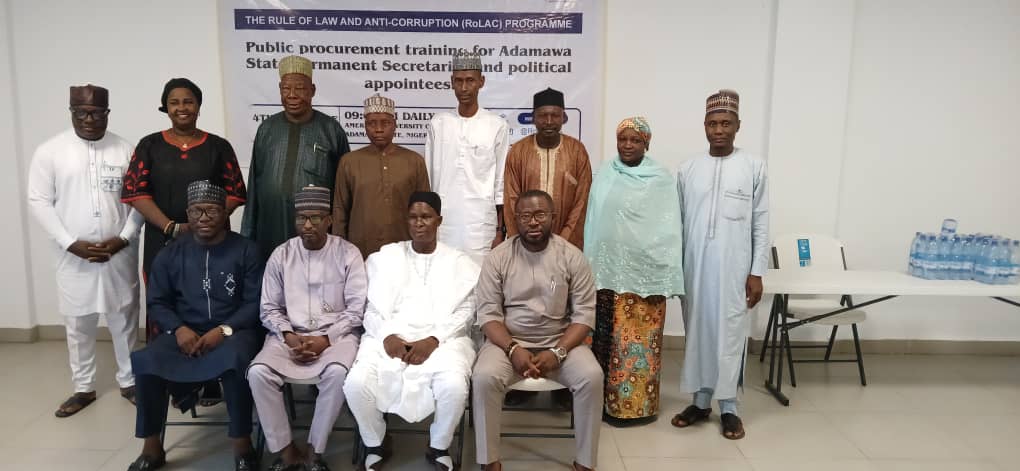
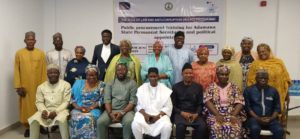
The initiative, backed by the European Union-funded Rule of Law and Anti-Corruption (RoLAC) programme and implemented by International IDEA, brought together key stakeholders from across the state’s Ministries, Departments, and Agencies (MDAs) for a four-day capacity-building workshop delivered at intervals to different stakeholders.
Permanent Secretaries, Procurement Officers, staff of the Bureau of Public Procurement (BPP), and political appointees, including commissioners were rigorously trained on the rudiments and nuances of adopting best practices in procurement processes to enhance service delivery, reduce corruption and ensure value for monies spent in executing projects in the state.
Related news
RoLAC organizes two day training to address gaps in dispensation of SGBV cases in Adamawa
Optimal service delivery: ROLAC unveils Anti-corruption strategy in Adamawa
JSR: RoLAC holds one day workshop for journalists in Adamawa
The workshop was tailored to eliminate corrupt practices, promote adherence to international procurement standards, and bolster the delivery of quality public services to the people of Adamawa State.
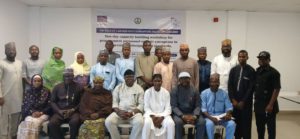
The event was facilitated in collaboration with the Adamawa State BPP and the Office of the Head of Civil Service (ADSACS Secretariat).
It provided a platform for participants to deepen their understanding of procurement laws, share experiences, and agree on strategic reforms needed to improve transparency and ethical conduct in procurement.
At the end of the workshop, participants released a communique capturing the deliberations, insights, and key resolutions reached during the sessions. The communique reflected a shared commitment to instilling global best practices into Adamawa’s procurement landscape.
Key Observations and Challenges
The training uncovered several structural and operational challenges hindering the effectiveness of procurement officers in the state.
Among the most prominent was the difficulty procurement personnel face in executing their responsibilities in line with the Adamawa State Public Procurement Law of 2020 (as amended).
Participants cited a lack of operational independence and undue external influence as impediments to the integrity and competitiveness of procurement processes.
Another recurring issue was the persistent delivery of substandard goods and services, often stemming from weak oversight and poor compliance with procurement standards. Participants expressed concern that this undermines the value for money in public projects and weakens public trust.
Furthermore, the exclusion of procurement officers during critical phases of budget formulation and planning was noted as a significant bottleneck. This gap often leads to misaligned procurement priorities and poor implementation of projects.
Lack of community involvement in procurement decisions and limited peer-to-peer learning opportunities among procurement personnel also surfaced as another pressing concern.
Participants also identify uneven access to professional development and limited institutional support for training across MDAs as another factor affecting the competence and morale of procurement officers. Some participants reported inadequate access to employment-related entitlements and career advancement opportunities.
Strategic Recommendations
In response to the identified challenges, the communique proposed a comprehensive set of recommendations to strengthen procurement integrity and efficiency in Adamawa State.
A central recommendation was the need for greater stakeholder engagement across all MDAs to support the procurement function and ensure compliance with legal and institutional frameworks.
The communique emphasized the urgent need for all government institutions to prioritize the full implementation of the Adamawa State Public Procurement Law, 2020. This would guarantee a uniform approach to procurement processes and reduce inconsistencies in policy execution.
Participants also called for the integration of procurement personnel into all phases of the budget cycle—from planning to execution. This measure would enable better procurement planning, improved execution, and more effective monitoring of projects.
To increase accountability and public trust, the communique recommended mechanisms that allow communities to participate in procurement planning, monitoring, and reporting. Such participatory approaches are expected to enhance transparency and foster local ownership of public projects.
Another proposal was the introduction of periodic peer review and benchmarking exercises among MDAs, local government authorities, and tertiary institutions. These initiatives would promote mutual learning, continuous improvement, and institutional growth.
The participants also advocated for sustained investment in the professional development of procurement officers. They urged MDAs to allocate dedicated funding for staff training and explore partnerships with development agencies to support capacity-building initiatives.
The participants reaffirmed their collective commitment to uphold ethical practices, transparency, and accountability in line with national laws and global procurement standards.
Acknowledgements and Commitment
Participants expressed profound appreciation to RoLAC programme and its implementing partner, International IDEA, for their strategic support. They also extended gratitude to the Adamawa State Bureau of Public Procurement and the Office of the Head of Civil Service for coordinating the event.
The training was hailed as timely and impactful, with many describing it as a catalyst for more professional and transparent procurement processes in the state. Participants voiced hope for the institutionalization of similar workshops in the future, underscoring the importance of continuous learning in sustaining reforms.
The communique was officially signed by members of the Drafting Committee—Thomas Indi, Hassana Musa, Sadiq Abubakar, and Calvin Enock Swade—on behalf of all participants.