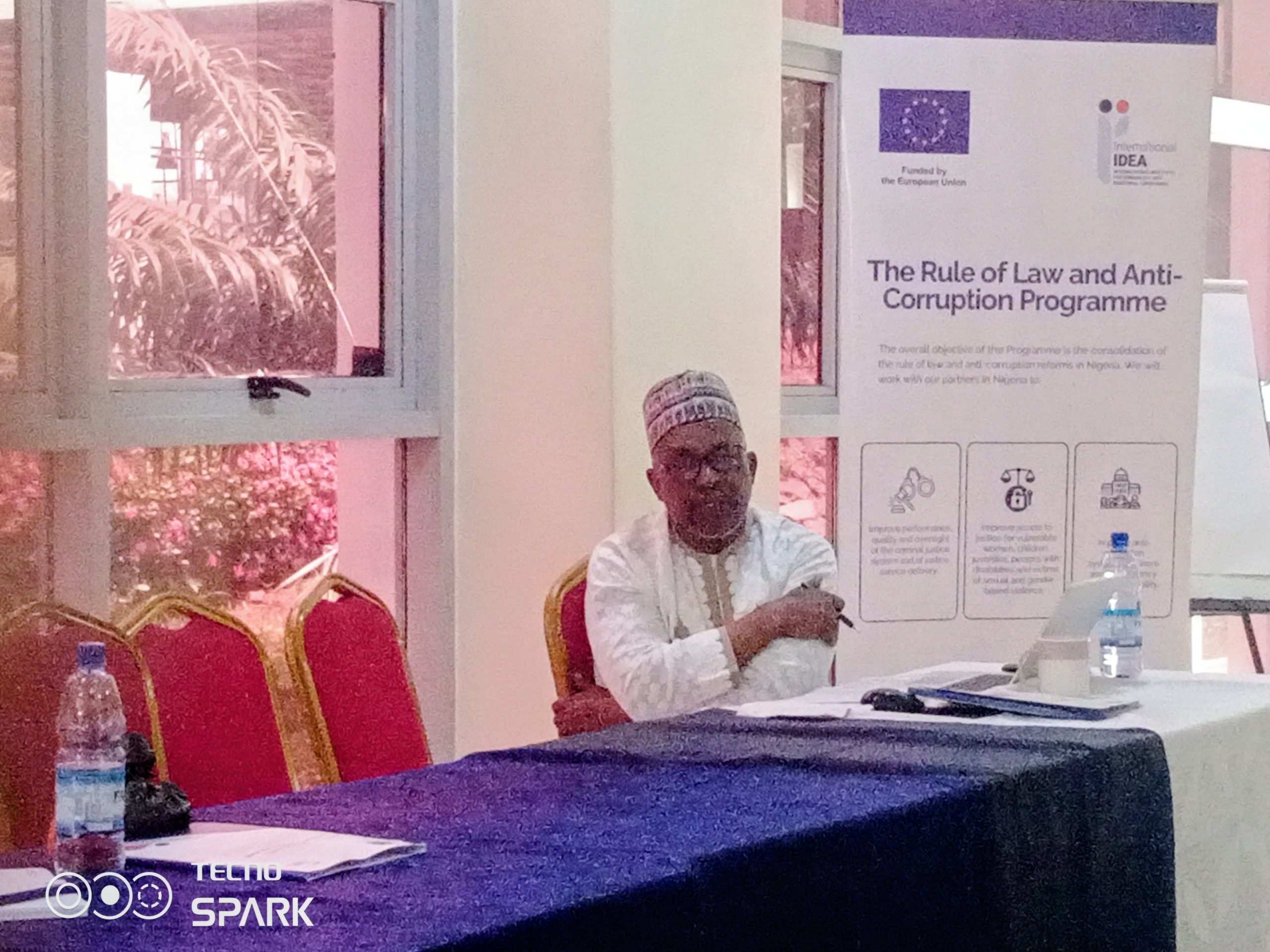

New ACJ reforms gradually taking shape in Adamawa – Prof Tabiu Mohd
Professor Tabiu Mohammed has lauded the steady progress being recorded in the Administration of Criminal Justice (ACJ) in Adamawa State, noting that such progress mirrors the tremendous efforts by the Justice Sector Reform Team (JSRT) and the Administration of Criminal Justice Monitoring Committee (ACJMC) as well as the subgroups constituted to ensure seamless implementation of the ACJ.
The event was organized by the Rule of Law and Anti Corruption Programme (RoLAC) funded by the European Union implemented by the International Institute for democracy and Electoral Assistance (IDEA).
Related news
Optimal service delivery: ROLAC unveils Anti-corruption strategy in Adamawa
RoLAC organizes two day training to address gaps in dispensation of SGBV cases in Adamawa
Justice Sector in Adamawa bolstered as stakeholders adopt key strategies
Tabiu Mohammed (SAN), who spoke after a meeting of the committees in Yola, said the reforms are gradually reshaping the justice sector by promoting efficiency, coordination, and access to justice for citizens.
Prof. Mohammed explained that the JSRT, alongside the ACJMC and other sub-committees, was established to drive reforms through proper planning, monitoring, and advocacy.
He noted that the committees have developed an action plan that prioritizes critical areas in justice administration, ranging from inter-agency collaboration to the adoption of technology in court processes.
“The team is responsible for ensuring coordination between the different justice sector institutions, including the Ministry of Justice, the judiciary, and other agencies.
“Our focus is to make sure that provisions of the Administration of Criminal Justice Act and the Correctional Service Act are effectively implemented,” he said.
He added that the reforms are also designed to strengthen access to justice for citizens, particularly through institutions such as the Citizens’ Rights Department, the Legal Aid Council of Nigeria, and civil society groups like the International Federation of Women Lawyers (FIDA) and the Nigerian Bar Association (NBA).
Prof. Mohammed highlighted some of the persistent challenges facing the criminal justice system in Adamawa State and across Nigeria. These include the slow pace of case disposal in courts, prison congestion, inadequate access to legal aid, and the absence of suitable custodial facilities for child offenders.
“These are critical challenges, but for the first time, we now have a body that is focusing directly on them with well-thought-out strategies.
“The good thing is that all stakeholders from the judiciary to the Human Rights Commission, NDLEA, Civil Defence Corps, and even the media are fully involved and committed to addressing these issues,” he added.
According to him, while progress is visible, the scale of the challenge requires greater political will and institutional support.
He urged the legislature, judiciary, and executive arms of government to give higher priority to justice sector reforms and to allocate more resources to sustain the momentum.
Despite the difficulties, Prof. Mohammed expressed optimism about the direction of the reforms. He pointed to the collaboration among stakeholders, which he described as unprecedented, as a major driver of hope for the justice system.
“I can see signs of progress. I can see hope that these problems are being addressed. But I am also aware that significantly more needs to be done.
“The authorities must continue to give attention to improving the administration of justice, while we sustain advocacy to ensure reforms are taken seriously at the highest levels of government.”
He stressed that the advocacy efforts of the committees have already begun to yield results by drawing the attention of policymakers and political leaders to the pressing needs of the justice sector.
One of the key strengths of the reform drive, Prof. Mohammed noted, is the quality of leadership guiding the process. The ACJMC is chaired by the Chief Judge of Adamawa State, while the JSRT is led by the Solicitor General.
“This strong leadership structure gives us confidence. With the dedication I have seen from the members of these committees, and the partnerships they have built, I am confident that more progress will follow.”