
From training to transformation: Dr Girei calls for swift reforms in teacher education
By Mohammed Ismail
Dr Salihu Bakari Girei has called for urgent reforms in Nigeria’s Colleges of Education, urging a shift from the traditional teacher-training model to a comprehensive system that transforms teachers into innovative, digitally competent and research-driven professionals capable of improving learning outcomes and advancing national development.
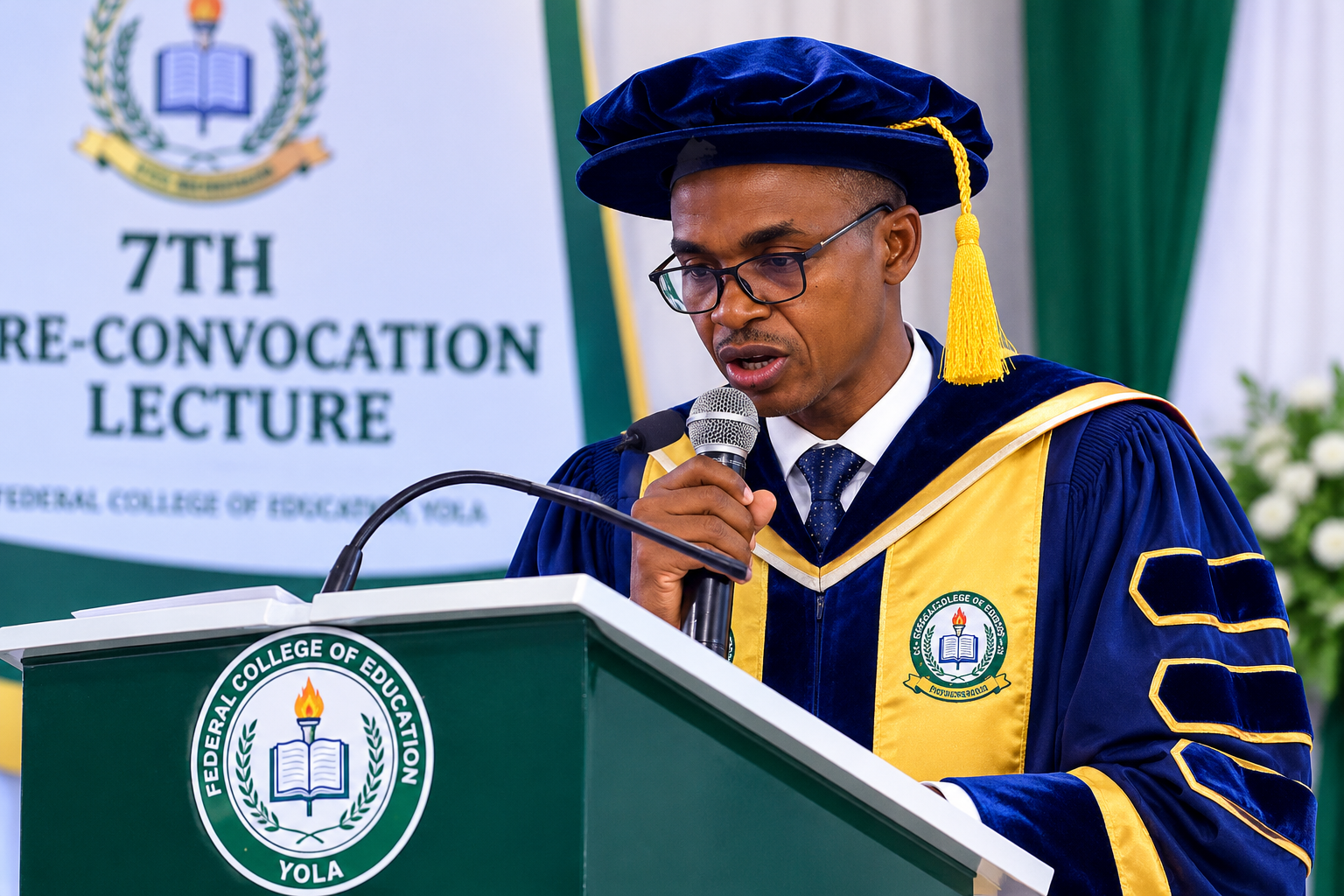
Girei made the call while delivering the 7th pre-convocation lecture of the Federal College of Education (FCE), Yola, Adamawa State, titled “From Teacher Training to Teacher Transformation: Re-imagining Nigeria’s Colleges of Education for Quality Education and National Development in the 21st Century.”
Related news
Adamawa govt pledges to partner Lincoln University to boost quality education
He argued that Nigeria’s education system could not achieve meaningful improvement without rethinking how teachers are prepared, supported and developed throughout their careers.
According to him, the challenge facing Colleges of Education is no longer simply how to produce more qualified teachers, but how to develop professionals equipped to respond to changing classroom realities, technological advancement and the demands of a knowledge-driven economy.
Girei maintained that the traditional mandate of Colleges of Education remained relevant, but the methods and institutional capacities required to fulfil it must evolve with changing times and societal needs.
He explained that teacher transformation should involve professional identity, improved teaching methods, digital and artificial intelligence (AI) competence, research capacity, ethical judgment and a commitment to lifelong learning.
“The teacher of the twenty-first century must be more than a transmitter of information,” he argued, describing the modern teacher as a learning designer, facilitator, mentor, researcher, reflective practitioner, community builder and responsible user of technology.
The lecturer said the rapid growth of digital technology and artificial intelligence had changed access to educational information but had not eliminated the need for effective teachers.
Although AI tools can generate lesson plans, explanations, assessments and other educational materials, he noted that access to information alone does not guarantee learning.
He stressed that teachers must acquire the skills to use technology responsibly, evaluate information, design effective learning experiences and ensure that digital tools support rather than undermine the educational process.
Girei also called for greater attention to ethics, inclusion, adaptability and critical thinking in teacher preparation, arguing that these competencies were necessary for teachers to respond effectively to diverse learners and emerging educational challenges.
He said weak teacher-preparation systems could undermine the entire education sector, while a well-supported teaching workforce could contribute to improved learning, innovation, social cohesion and economic productivity.
Girei distinguished teacher training from teacher transformation, explaining that training often concentrates on the knowledge and skills prospective teachers need at the point of qualification, while transformation focuses on the kind of professionals they become throughout their careers.
He called for Colleges of Education to evolve into professional learning institutions where teachers continually improve through research, collaboration, mentoring, practical experience and sustained professional development.
According to him, professional development should not be limited to occasional workshops or the acquisition of certificates. It should be sustained, connected to classroom practice and assessed by its contribution to students’ learning.
He urged institutions to strengthen the relationship between research and teaching practice, noting that educational research would have limited value if its findings were not applied to solve problems in schools and communities.
The lecturer also emphasised the need to attract talented young people into teaching, prepare them rigorously, provide opportunities for career development and reward professionalism to make the profession more attractive and sustainable.
Girei cautioned that transforming Colleges of Education required more than constructing new facilities, introducing revised curricula or providing digital equipment.
He said meaningful reform demanded a change in institutional culture, with greater emphasis on accountability, innovation, collaboration, evidence-based decision-making and continuous learning.
He advocated stronger partnerships among Colleges of Education, schools, government agencies and other stakeholders to ensure that teacher preparation reflected the actual needs of classrooms and the wider society.
The lecturer further called for responsible adoption of technology, improved research capacity and institutional support systems that would enable teachers to remain effective amid changing social and economic conditions.
He described teacher transformation as part of a wider national development agenda, arguing that the quality of teachers directly influences the quality of education and the capacity of citizens to contribute to national progress.
Reviewing the lecture, the chairman of the occasion, Professor Liman Tukur, urged teachers to continually improve their professional knowledge through research, training and career development.
Tukur said transforming the education system required the participation of all stakeholders, including teachers, educational institutions and policymakers.
He particularly challenged institutions to promote the sharing and practical application of research findings, warning that research outcomes kept on shelves would do little to advance society.
He urged educators to move beyond producing academic work for record purposes and ensure that their findings contributed to solving real-life problems and improving teaching and learning.