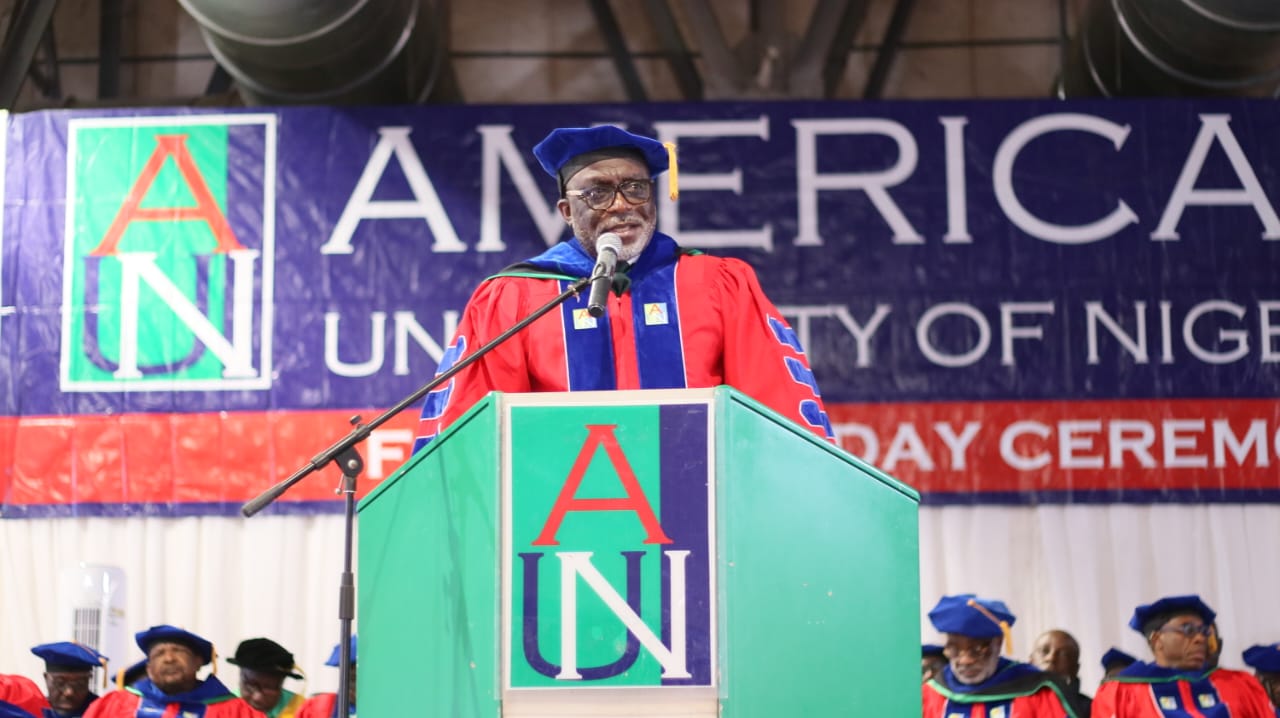

AUN founder’s day: United Nigerian Airlines boss, charges Nigerian graduates to be job creators not seekers
•Praises Atiku’s sustained investment in education, scholarship commitment to AUN students; says education must produce innovators, problem-solvers and responsible citizens
The Chairman of United Nigeria Airlines, Professor Obiora Okonkwo, OFR, has challenged Nigerian youths and university graduates to move beyond the pursuit of academic certificates and embrace innovation, entrepreneurship and value creation as instruments for national development.
Okonkwo, who delivered the 2026 Founder’s Day Lecture of the American University of Nigeria (AUN), Yola, on Saturday, November 21, 2026, urged young people to see themselves not merely as seekers of employment but as potential employers of labour and contributors to the transformation of society.
Also read
MAAUN mourns Int’l academic and mgmt association president, Prof. Bikash Sharma
Dep Gov Farauta Speaks At AUN Intl Conference Proffer Solutions To Food Insecurity
MAAUN founder Gwarzo celebrates North’s first female clinical pharmacy professor, Ma’aji
Speaking on the theme, “Purposeful Education and the 21st-Century University: Leadership, Innovation and Social Responsibility,” the academic argued that the true measure of education lies not in the prestige of academic qualifications or positions attained but in the problems graduates can solve, opportunities they create and lives they improve.
Addressing students and alumni of AUN, he charged them to approach life as value creators and contributors to national development rather than passive beneficiaries of societal resources.
“You must, therefore, approach life with the consciousness of value creators and value givers, rather than merely as claimants upon the resources of society; as contributors to national development, rather than as passive beneficiaries of public investment; and, wherever possible, as employers of labour rather than merely seekers of employment,” he said.
He further urged the younger generation to embrace vocational skills, entrepreneurship and technological innovation, stressing that the world needs graduates who can translate knowledge into practical solutions to human problems.
“Let your education become a platform for invention, enterprise, productive engagement, and the advancement of human welfare. Let your knowledge find expression in solutions; let your creativity generate opportunities; let your technological competence address real human needs,” he advised.
Okonkwo maintained that purposeful education must go beyond the acquisition of academic qualifications to developing the intellectual, ethical, practical and civic capabilities required for individual fulfilment and collective progress.
According to him, possessing a university degree does not automatically translate into the ability to identify problems, develop solutions, communicate effectively, collaborate or exercise sound judgement.
He argued that universities must therefore place greater emphasis on what students can understand, create, evaluate and accomplish rather than simply what they have been taught or the certificates they eventually receive.
The lecturer, however, cautioned against reducing university education to vocational training, noting that societies still require strong disciplinary knowledge in engineering, medicine, law, economics, agriculture, literature, computing, history and the sciences.
He advocated a balanced educational model that combines specialised knowledge with critical thinking, communication, ethical reasoning and the ability to work across disciplines.
Praises Atiku’s investment in education
A significant part of the lecture was devoted to the contributions of AUN founder and former Vice President of Nigeria, Atiku Abubakar, GCON, whom Okonkwo commended for his sustained investment in education and commitment to expanding access to quality higher education.
Describing Atiku as a visionary statesman and outstanding institution builder, the lecturer said the former Vice President’s contribution to AUN went far beyond establishing a university, representing an extraordinary personal commitment to transforming higher education in Nigeria and Africa.
He particularly praised the founder’s sustained financial support to the institution through annual subventions, scholarship opportunities for students, relatively affordable tuition and continued investment in initiatives aimed at strengthening the university’s academic standing.
Okonkwo also commended Atiku’s commitment to sponsoring students on scholarship to study at AUN, describing such support as a practical demonstration of his conviction that financial limitations should not prevent talented young Nigerians from accessing quality education.
He noted that the former Vice President had consistently demonstrated that education, particularly higher education, was a transgenerational investment in national advancement and the cultivation of an enlightened, productive and transformed society.
According to him, Atiku’s commitment to supporting students and sustaining the institution reflects an understanding that the benefits of education extend beyond individual beneficiaries to their families, communities and future generations.
“Your Excellency, Sir, thank you for demonstrating, in the most practical way, that education, particularly higher education, is a transgenerational investment, not just in national advancement but also in the cultivation of a more enlightened, productive and qualitatively transformed humanity,” he said.
The academic also used the occasion to celebrate Atiku on attaining the age of 80, describing him as an iconic statesman whose contributions to humanity and national development deserve enduring recognition.
He expressed gratitude for the former Vice President’s continued good health and prayed that he would live many more years to make further contributions to Nigeria and the world.
Okonkwo equally commended Senator Ben Obi, CON, for his institutional leadership and contribution to AUN’s progress, while expressing confidence in the capacity of the university’s President, Dr DeWayne Frazier, to advance its academic and developmental aspirations.
AI, innovation and the future of universities
On the challenges confronting contemporary universities, Okonkwo identified artificial intelligence, automation, digital transformation, climate change, insecurity, inequality and changing labour-market demands as issues reshaping the future of higher education.
He warned that technological advancement and increased access to information must not be mistaken for deeper understanding, arguing that universities must preserve critical inquiry, intellectual independence and academic integrity in an era increasingly influenced by artificial intelligence.
He called for greater investment in interdisciplinary learning, research, digital competence, entrepreneurship and ethical reasoning to prepare graduates for occupations and challenges that may emerge or change significantly during their working lives.
The lecturer maintained that universities must equip students not only for existing professions but also for a rapidly changing world in which continuous learning, adaptability and technological competence would become increasingly important.
He also emphasised the importance of research as a public good and an instrument of development, urging universities to produce knowledge that can inform public policy, improve professional practice, support enterprise and address community challenges.
He identified inadequate research funding, weak infrastructure, limited data systems and insufficient collaboration between universities and productive sectors as some of the constraints undermining research development in Nigeria.
Calls for stronger university-community partnerships
On social responsibility, Okonkwo said universities must look beyond occasional donations and charitable activities to establish sustainable relationships with surrounding communities.
He advocated reciprocal community engagement in which universities and local communities work together to identify problems, design interventions and evaluate their outcomes.
He further called for inclusive educational opportunities, accessible facilities, scholarships, mentoring and support systems that enable students from disadvantaged backgrounds to realise their potential.
According to him, a university’s responsibility to society is reflected not only in the quality of its graduates but also in its research, employment practices, environmental sustainability and contribution to the welfare of surrounding communities.
On the relationship between international education and national development, the lecturer maintained that global academic standards and local developmental priorities should complement rather than compete with each other.
He said an internationally oriented university must draw from global knowledge, research networks and best practices while remaining responsive to the realities and developmental needs of its immediate environment.
Describing AUN as a distinctive institutional experiment, Okonkwo said its founding philosophy as a Development University placed social transformation at the centre of its academic mission.
He noted that the institution was established not merely to provide another option in Nigeria’s higher education landscape but to demonstrate how international educational practices could be mobilised to address development challenges in Nigeria, Africa and the wider world.
He maintained that AUN’s location in Yola provides an opportunity to demonstrate that a university situated in northeastern Nigeria can attain international academic relevance while contributing meaningfully to regional and national development.
He urged the institution to deepen its research, innovation, community engagement, international partnerships and sustainability initiatives while strengthening its capacity to measure the actual impact of its programmes.
A charge to the younger generation
In his concluding message to students, alumni and aspiring members of the AUN community, Okonkwo urged young Nigerians to recognise that the value of education extends far beyond personal advancement, professional success and material prosperity.
He challenged them to become instruments of positive transformation in their communities, using their knowledge, creativity and acquired competencies to generate opportunities and improve human welfare.
He particularly encouraged them to embrace entrepreneurship and technological innovation, insisting that the world needs graduates who can move beyond identifying problems to imagining, designing and implementing solutions.
The lecturer’s message was that academic qualifications should serve as a foundation for productive engagement, innovation and responsible citizenship rather than become an end in themselves.
The 2026 Founder’s Day Lecture provided an opportunity for AUN to reflect on its founding philosophy as a Development University and reaffirm its commitment to connecting international academic excellence with Nigeria’s developmental aspirations.
It also reinforced the enduring argument that the ultimate success of a university should be measured not merely by the certificates it awards, the research it publishes or the recognition it receives, but by the quality of people it produces, the problems they solve and the positive difference they make in society.