How Galadima’s candidature returns harmony between Fintiri and Yola town
By Mohammed Ismail.
The people of the ancient city of Yola have expressed profound ecstasy over the renewed harmony between governor Ahmadu Umaru Fintiri and the town since Tijjani Ahmed Galadima emerged Adamawa State governorship candidate of the ruling All Progressives Congress (APC).
They said the development has the prospects of positive tidings for the residents of Yola who feel neglected and abandoned in terms of government patronage and developmental strides compared to Jimeta, a siamese town which recieved high government priority and attention.
Related news
APC reps primaries: Protest erupts in Numan as stakeholders accuse Fintiri of betrayal
Fintiri, Mustapha Salihu, GPF and a passing infatuation
The people noted that in the new camaraderie, lies the hope of a better future for the town as governor Fintiri finishes the last lap of his tenure.
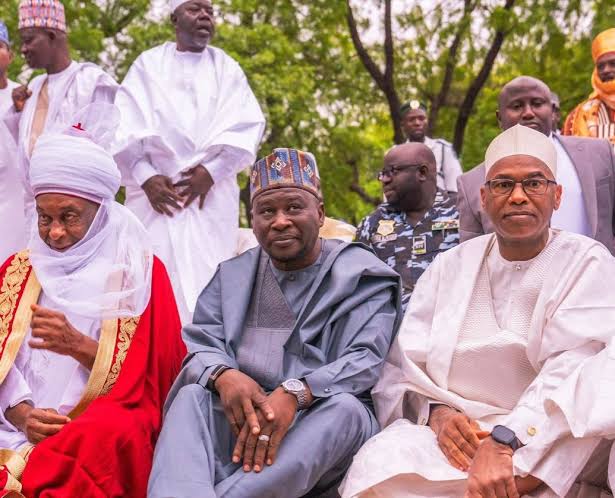
This optimism was expressed following the governor’s first observance of Sallah celebration in Yola in many years.
Sources close to Adamawa emirate told our reporter in confidence that the governor stopped attending the important cultural and religious festival since 2023 after securing his second term shortly before he fell apart with his major benefactor, former vice president Atiku Abubakar who doubles as the Waziri Adamawa, “second in command in the emirate’s leadership hierarchy.”
Findings by this paper indicated that hitherto, Muslim governors, usually perform the two Sallah festivals; Eid-el-fitr and Eid-el-kabir with Lamido of Adamawa as a mark of respect to a long established cultural and religious tradition.
But Fintiri was the first governor in history who defied that culture and shunned attending the two Sallah events despite the role Atiku played in bringing him to power in 2019 and 2023.
Sources privy to developments maintained that Fintiri’s action of defying the emirate may not be unconnected to the alleged partisan role Lamido played in the build up to the 2019 and 2023 governorship elections.
But whatever may be the reason for the governor’s actions, the distrust between him and the foremost traditional ruler has overtime become so palpable. What made the frosty relationship even more glaring was the alleged harshness of Fintiri towards Lamido underpinned by scorched earth policies.
Some of the harsh policies allegedly directed at the traditional ruler include a stipulation that traditional rulers must attend government functions failure of which may attract stiff penalties including suspension especially if such failures are related to ill health and incapacitation to perform duties. Many believed that the sole target of that action was Lamido as his absence from public functions were allegedly linked to poor health condition.
The controversial unbundling of the emirate which has become a subject of litigation was another action that became a major reference point in the Fintiri, Lamido brouhaha.
Apart from shunning the significant cultural and religious festival, Fintiri has cancelled another well established event in which traditional rulers in the state pay homage to the governor during Christmas and Sallah festivities ostensibly to avoid contact with the Lamido as whispers suggested.
But with the emergence of Tijjani Galadima, the governor has also restored the traditional Sallah homage as witnessed recently.
Apart from the friction between the governor and Lamido, the people of Yola believed that the town which deserves a lot of attention based on its deep historical roots and heritage was neglected and abandoned in favour of Jimeta.
A resident of Yola, Sani Biri who decried the alleged injustice, said, both Yola and Jimeta constitute the capital of Adamawa State and for its history and deep heritage, the name of Yola was adopted as the state capital. But despite that, the town was grossly undermined in terms of patronage by governor Ahmadu Umaru Fintiri’s administration.
He noted that while Jimeta benefitted from projects running to hundreds of billions of naira, Yola only received a tap on the back.
”The only real capital project in Yola was the reconstruction of Yola market which is adjudged to be below standard coupled with pockets of road networks. This pale into insignificance compared to the multi billion naira projects which dotted the landscape of Jimeta. This is the height of injustice,” Biri said.
Another source close to the Adamawa emirate told our reporter that Fintiri’s aggression towards Lamido was real and deliberate to undermine both the emirate and the revered traditional ruler. Our source noted that the provision requiring that any emir or chief will be replaced over incapacitation in relation to I’ll health was a constitutional matter, but pointed out that the provision was weaponized by Fintiri against the Lamido.
“The unbundling of the Adamawa emirate and other harsh policies are not mere happenstances. They were deliberately designed and weaponized to undermine the Lamido. The worst part is the recent action in which emirs and chiefs were directed to converge at government house during the last visit of president Bola Ahmed Tinubu to Adamawa State.
“The normal protocol is that whenever the president is coming, traditional rulers will be hosted at Lamido’s palace where the president usually addresses them. This has been the practice since colonial time. But in a move to undermine Lamido, Fintiri has now changed the rule as emirs and chiefs are now mandated to come and wait for the president in a rather disgusting and humiliating manner.
“Some of the traditional rulers where stationed at government house throughout the day under conditions that may be inimical to their health and well being. Due to health issues some of them can’t stay in air conditioned places vice versa, that is a serious abuse meted to the revered institution,” our source said.
The indignation was coming against the backdrop of a rabid political screed penned down by Aminu Iyawa, a former commissioner and Ambassador who accused Fintiri of vindictiveness and ethnic exclusion against the Fulani race.
In his treatise entitled “The king who fell to the mosquito” which has drawn sharp rebuke from the government circles and generated mixed conversations across the state, accused Fintiri of tyrannical tribalism.
”When the outgoing Adamawa State Governor, Alhaji Ahmadu Fintiri, consolidated his second term, after being reelected in 2023 through means that were even contested at the courts by the APC but lost, he completely transmute to a tyrannical tribalist.
”While I cannot take away the developmental impact he made in terms of provision of infrastructure, especially roads within the state capital, his tone, whenever he spoke, became incendiary to dividing citizens.
”Fintiri has a binal personality. So is his thinking. He is caught between two worlds; one that is designed for him by a tribal group that dictated its agenda to him to prosecute and, on the other hand, he pretends to play the role of a messianic democrat who is out to emancipate a section of the people from imaginary enemy.
”Until few weeks ago, he could not hide his hatred for a section of the Adamawa populace – the Fulbe, based on unsubstantiated horrific accounts of how nearly 200 years ago, long before the British, the French and the Germans invaded the original Adamawa emirate and partitioned the land in to Nigeria, Cameroon and the German colony that had no name, a Fulani district head that ruled over what is now Madagali, Gulak and Uba communities with iron fists, showed no mercy on his subjects for the slightest wrong doing.
”Even if the story of this evil ruler were true, the Marghi and other tribes that occupy this area had since 1963, had their rulers come from within the community,” Iyawa said.
In another treatise penned down by Yunusa Mohammed, a lecturer with Nasarawa Poly, entitled “Fintiri, Iyawa And The Politics Of Selective Memory” the lecturer justified the alleged exclusion of certain groups under Fintiri dismissing the government’s response as face saving measure.
”Malam Aminu Iyawa’s essay, “The King Who Fell To The Mosquito,” may have been emotionally loaded, metaphorically militant and politically provocative but it resonated widely because it touched a sensitive nerve already exposed in the hearts of many Adamawa citizens.
”The applause that greeted Iyawa’s intervention across political and social circles did not emerge from empty sentiment; it sprang from accumulated anxieties, suppressed frustrations and silent sufferings that many citizens believe the current administration either ignored or deliberately deepened.
”The Commissioner’s response attempted to paint Governor Ahmadu Umaru Fintiri as an almost saintly statesman standing above tribal temptation and political vindictiveness. Yet public memory is stubborn. Propaganda may perfume perception temporarily but lived realities eventually overpower lyrical government literature.
”What Iyawa essentially deconstructed was not merely a Governor but a governing disposition; one increasingly perceived by critics as punitive, prideful and politically unforgiving.
”Across Yola and Jimeta, conversations continue to swirl around the controversial demolitions that displaced countless small-scale traders, struggling entrepreneurs and petty business owners without adequate alternatives or sustainable relocation frameworks,” Yunusa Mohammed said.
Another dimension to the alleged neglect of Yola was the glaring failure of the government to take a proactive measure to construct drainages or chart alternative waterways in order to safeguard lives over the prospects of another impending and devastating floods in 2026 rainy season which NIMET said will be accompanied by raging flood and storms.
Last year, a devastating flood has ravaged residents of Shagari quarters, Yolde Pate, Sabon Pegi and surrounding environments leading to the deaths of several residents. But as if to add salt to a festering injury, the government donated expired food stuff during its first intervention eliciting condemnation and public outrage.
The governor during his visits to affected areas promised to ensure such deadly and avoidable human carnage did not happen again by constructing new drainages and waterways just as he vowed to demolish structures built on waterways.
”As I’m talking to you, nothing has been done. This shows you that this government places more priority in cosmetic projects that have no real meanings to lives of the people to projects meant to safeguard lives,” A resident of one of the submerged communities in Yola, Alexander John told our reporter.
Another resident, Salihu Baba said “It is unfortunate that this government seems to have placed premore to aesthetics and beautification of the state capital at the detriment of human beings. I lived in this community for over 15 years and flood of last year was my first experience with such a tragedy.
“We believed that it was caused by an illegally constructed dam for mining activity. But the government later said the dam was not responsible for the flood. On two occasions, the governor came to us and gave us assurances that he will construct waterways and demolish structures built on waterways.
“Engineers were sent to mark buildings for demolition while areas for the construction of waterways were benchmarked but up till now nothing was done. This shows you the extent of government’s carefree attitude towards lives and properties to protect.
“I find it difficult to fathom why a governor who spent billions of naira to construct bridges where there is no water for the expediency of beautifying the state capital will find it difficult to construct mere storm drainages to save lives. This is the height of insensitivity,” he said.
Another resident, Hamidu Misa said despite the huge funds brought to the state by the federal government and other donors, victims were mainly left to their fate.
“In my area, dozens of houses were destroyed but only three people including me were given some sort of palliatives. I don’t know for others but I was given only N130,000. That amount could not even reconstruct my destroyed fence let alone rebuild my house. We are currently in a state of double tragedy because we were neither compensated and our future remains in serious danger as the storm and flood may happen again since the underlying issues that caused it were yet to be addressed,” he said.
Efforts to speak with the CPS to the governor, Humwashi Wonosiko prove abortive as an Whatsapp message sent to him on the subject was yet to be responded to as at the time of filing this report.