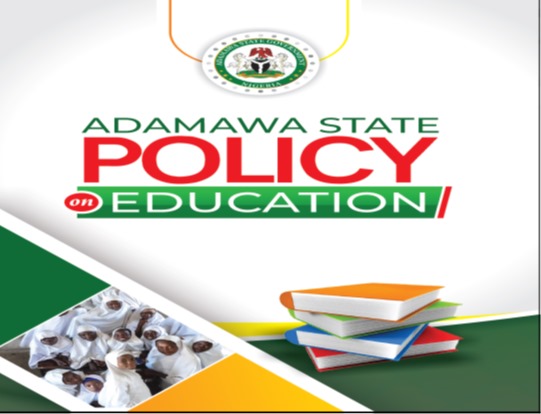

Assessing Gender Responsiveness of the 2024 Adamawa State Policy on Education: Can It Deliver on Its Promises?
By Obidah Habila Albert
Adamawa State is charting a new course toward educational transformation. The state’s bold initiatives in education policy are not just bureaucratic exercises, they are carefully crafted roadmaps aimed at unlocking a future where every child, particularly girls, has equal access to quality learning opportunities. Yet as the policies are rolled out, a critical question emerges: Are these comprehensive policies truly addressing the specific needs of girls, and will they deliver on their promise of inclusion and empowerment?
A Vision for Inclusivity
The Adamawa State Policy on Education, developed by the Ministry of Education and Human Capital Development and launched in December 17, 2024, paints a vivid picture of an inclusive, equitable, and high-quality educational landscape. The document is clear about its vision: to create a framework that leaves no learner behind regardless of gender, socio-economic status, or geographical location. This forward-thinking approach is a direct response to the historical disparities that have often sidelined girls in education.
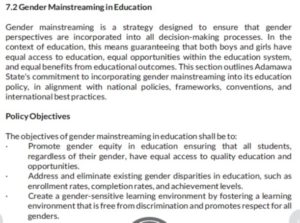
The policy pointed out universal access as its cornerstone, seeking to level the playing field in a region where access to education has been marred by systemic inequities. It advocates for a learning environment that fosters equal opportunities, laying the foundation for girls to not only enter the classroom but also thrive within it. This vision is ambitious, aiming to transform societal norms and empower girls to overcome traditional barriers that have long hindered their academic pursuits. Central to this vision is the understanding that education is a key driver of socio-economic development. For girls, in particular, education offers a pathway to independence and self-determination — a tool that can break cycles of poverty and discrimination.
Related news
Is Adamawa’s Education Sector Planning Missing Its Most Vital Stakeholders?
Two more Adamawa LGs to be free from open defecation as UNICEF unveils DGIS – ASWA III
GRESP: FAWE, HILWA unveil resilient model for uninterrupted girl education in Adamawa
Gender Mainstreaming in Education
One of the most compelling features of the policy is its commitment to gender mainstreaming. This approach goes beyond simply counting the number of girls enrolled in schools. It involves a comprehensive integration of gender perspectives into every facet of the educational system, from policy formulation to curriculum design, teacher training, and beyond.
Gender mainstreaming means rethinking the educational process to ensure that the specific needs and challenges faced by girls are addressed head-on. The policy calls for a detailed gender analysis, identifying systemic disparities such as gender biases in textbooks, unequal access to quality teaching, and infrastructure challenges that uniquely affect girls. For example, in Government Day Secondary School Badarisa, Adamawa State, the lack of safe and hygienic sanitation facilities has been a significant barrier to girls’ attendance.

Catherine Kiliobas, a 14-year-old JSS3 student of the school is one of many girls whose parents cannot afford to buy sanitary products regularly, and the school doesn’t provide them either. So, she often relies on donations from non-governmental organizations. Coupled with the poor state of the toilet facilities in her school, she usually skips school during her menstrual period. “To make matters worse, the school’s water supply often runs dry, rendering the toilets unusable for students,” Catherine said.
Through the recognition of such issues, the policy aims to create an educational environment where girls can feel safe, valued, and supported. This commitment is backed by the principles promoted by international bodies such as the UN Girls’ Education Initiative (UNGEI). These organizations have long advocated for gender-responsive planning, emphasizing that educational reforms must be tailored to dismantle long-standing biases and promote a culture of inclusion. In Adamawa State, the gender mainstreaming policy is seen as a critical step in aligning the state’s education system with global best practices and the Sustainable Development Goals (SDGs) 4 and 5.
Strategies for Girls’ Education
While the overarching vision and gender mainstreaming approach provide a detailed framework, the real test lies in the implementation of targeted strategies designed to uplift girls. The policy lays out specific interventions that aim to boost girls’ enrollment and retention in schools, thereby ensuring that the promise of gender equity is translated into measurable outcomes.
Recognizing that financial constraints are a major deterrent to girls’ education, the policy advocates for the provision of scholarships and bursaries. These financial aids are targeted at girls from disadvantaged backgrounds, ensuring that economic barriers do not prevent them from accessing quality education. The goal is to create a supportive financial ecosystem that encourages families to invest in the education of their daughters.
In Adamawa State, deeply rooted cultural norms can sometimes undermine girls’ educational pursuits. The policy takes a proactive stance by incorporating measures to address socio-cultural factors that hinder girls from continuing their education. This includes community sensitization programs aimed at changing perceptions about girls’ education and promoting the value of educating every child, irrespective of gender.
A critical component of the strategy is the development of policies to prevent and respond to gender-based violence in schools. Safety is paramount for creating an environment where girls can learn without fear. The policy mandates the establishment of clear protocols for handling cases of harassment and abuse, ensuring that schools remain safe havens for all students. Such measures are essential not only for protecting girls but also for fostering a culture of respect and dignity within the education system.
Infrastructure, Safety, and Support Services
The success of any educational policy is intricately linked to the physical and social environment in which learning occurs. The Adamawa State policy recognizes this by emphasizing the importance of gender-responsive infrastructure and comprehensive support services.
One of the state’s priorities is to ensure that schools are equipped with the necessary facilities to support both boys and girls. This includes the construction and renovation of classrooms, libraries, and laboratories, as well as the provision of separate sanitation facilities. Gender-responsive infrastructure is not merely about building walls and roofs; it is about creating spaces that are safe, inclusive, and conducive to learning.
Safety measures extend beyond infrastructure. The policy outlines protocols for creating secure learning environments where incidents of gender-based violence are promptly addressed.
Training for school staff on safety procedures and the establishment of monitoring systems are critical in ensuring that schools remain places of learning rather than sites of fear.
In addition to physical infrastructure, the policy places a strong emphasis on the psychosocial well-being of students. Guidance and counselling services are integral to the plan, offering gender-responsive support that addresses the unique challenges faced by girls.
These support services are seen as essential in not only improving academic outcomes but also in promoting mental health and resilience among students. In a region where socio-cultural pressures and economic hardships can severely impact a student’s educational journey, such services play a crucial role in ensuring that no girl is left behind.
Challenges and Opportunities in Implementation
Despite the comprehensive nature of the Adamawa State Policy on Education, the road from policy formulation to effective implementation is fraught with challenges. One of the most significant hurdles is ensuring that this detailed policy translates into tangible benefits on the ground. One of the key features of the education sector plan is its built-in mechanisms for monitoring and evaluation. Regular review processes and performance indicators are intended to hold the implementation process accountable. However, the success of these measures depends largely on the availability of accurate data and the willingness of all stakeholders to engage in continuous improvement. There is a pressing need for sustained oversight to ensure that the strategies not only remain relevant but also adapt to emerging challenges.
The financial framework within the policy is detailed and aims to secure both domestic funding and international aid. Yet, the actual mobilization of these resources remains a critical concern. Effective implementation requires not only sufficient funding but also efficient management of resources. Partnerships with private sector organizations, NGOs, and international donors are crucial in bridging funding gaps and bringing in additional expertise. However, these collaborations must be managed transparently to build public confidence and ensure that funds are used effectively.
Perhaps the most critical challenge is ensuring that the voices of all stakeholders — especially those of the communities directly affected by these policies are heard during the planning and implementation stages. Recent critiques have highlighted that many key players, including representatives from community organizations, religious groups, and frontline educators, have not been sufficiently involved in the process. The exclusion of these stakeholders raises concerns about whether the policies can fully address the specific challenges faced by girls. To truly empower the future, it is imperative that policy formulation becomes a truly inclusive process.
Charting the Way Forward
The Adamawa State Policy on Education stands as a bold testament to the state’s commitment to educational excellence and inclusivity. Its comprehensive approach — from universal access and gender mainstreaming to targeted strategies for girls, improved infrastructure, and extensive support services — lays a strong foundation for empowering the next generation of learners. Yet, the true measure of its success will depend on effective implementation and the ability to engage all stakeholders in a genuine, participatory process.
As Adamawa State continues its journey towards educational transformation, the focus must remain on creating an environment where every girl can achieve her full potential. This means not only designing policies that are visionary on paper but also ensuring that those policies are reflective of the real challenges faced by girls in the classroom and beyond. It requires a commitment to continuous improvement, transparent resource management, and, most importantly, an unwavering dedication to inclusive stakeholder engagement.
In the end, empowering the future is about more than just crafting strategic documents — it is about listening to the voices of those on the ground, harnessing their perspectives, and building an education system that truly serves all members of society.
This report was developed with collaborative support from ImpactHouse Center for Development Communication and System Strategy and Policy Lab (SSPL).