Economic empowerment: NCWS, ICW-CIF train Adamawa women on briquettes production
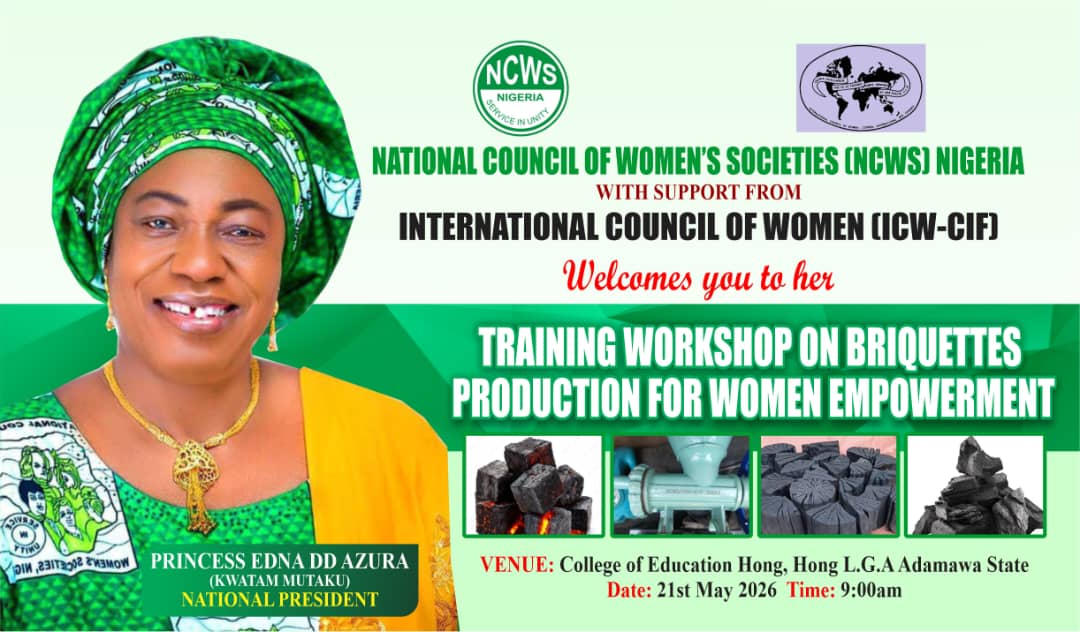
The National Council of Women’s Societies (NCWS), in collaboration with the International Council of Women (ICW-CIF), has organized a training workshop on briquettes production aimed at empowering women economically while promoting environmental sustainability in Adamawa State.
The workshop, held at Adamawa State College of Education, Hong, brought together women from various NCWS chapters across the state, as well as representatives of several women groups and organizations.
Related news
Adamawa journalist Ojoma, ADSPHCDA provide hygiene kits to 150 pregnant women
Haske leads APC women empowerment, reaffirms support for president Tinubu
Over 30,000 Adamawa women rally behind Haske’s governorship ambition
The event also attracted traditional leaders and stakeholders, including the paramount ruler of the Huba Chiefdom, Tol Alheri Bulus Nyako, who was represented by the District Head of Dugwaba, Chief Simon Yakubu.
Speaking during the training, the National President of NCWS Nigeria, Princess Edna Azura, popularly known as Kwatam Mutaku, stressed the urgent need to tackle the growing challenge of deforestation and environmental degradation.
She noted that the continuous and indiscriminate cutting of trees has contributed significantly to climate change, desertification, soil erosion, and rising temperatures, adding that women and children are often the worst affected because of their dependence on firewood for cooking and other domestic activities.
Princess Azura explained that the recent law enacted by the Adamawa State Government under Governor Ahmadu Umaru Fintiri banning tree felling further highlighted the need for alternative and sustainable energy solutions.
According to her, the workshop was designed to equip women with practical skills on how to convert waste materials commonly found within their communities into briquettes for cooking and household use.
She described briquettes as environmentally friendly, affordable, sustainable, and capable of reducing heavy reliance on firewood, thereby helping to preserve the environment and protect the ecosystem.
The NCWS President urged participants to maximize the opportunity provided by the training, noting that briquettes production goes beyond domestic use and can also serve as a viable source of income for women and their families.
During the practical sessions, participants were trained on how to produce briquettes using locally available materials such as chaff, groundnut shells, sawdust, rice husks, maize stalks, dry leaves, charcoal dust, and paper waste with the aid of locally fabricated machines.
One of the highlights of the workshop was a presentation by Mr. Ishaya Adamu on empowering women and girls through sustainable tree planting initiatives in Adamawa State.
Another major feature of the event was the donation of briquettes production machines by the NCWS National President to various state chapters to encourage continued production and training at the grassroots level.
In his goodwill message, the representative of the Huba Chiefdom described the workshop as timely, especially at a period when many households are facing economic hardship, environmental challenges, and the increasing cost of cooking fuel.
He commended NCWS and ICW-CIF for initiating the programme and for their commitment toward empowering women through practical and sustainable solutions capable of improving livelihoods and supporting community development.
Participants expressed appreciation to the organizers, describing the training as impactful, practical, and enlightening. They pledged to transfer the knowledge acquired to other women in their communities and intensify efforts toward environmental protection and economic self-reliance.
The workshop further underscored the commitment of the NCWS National President, Princess Edna DD Azura, toward improving the socio-economic wellbeing of women through innovative and sustainable initiatives.
At the end of the training, three briquettes-making machines were donated to support continuous training and production activities across the state.
Organizers also disclosed that a similar training ### NCWS, ICW-CIF Train Adamawa Women on Briquettes Production for Economic Empowerment
The National Council of Women’s Societies (NCWS), in collaboration with the International Council of Women (ICW-CIF), has organized a training workshop on briquettes production aimed at empowering women economically while promoting environmental sustainability in Adamawa State.
The workshop, held at Adamawa State College of Education, Hong, brought together women from various NCWS chapters across the state, as well as representatives of several women groups and organizations.
The event also attracted traditional leaders and stakeholders, including the paramount ruler of the Huba Chiefdom, Tol Alheri Bulus Nyako, who was represented by the District Head of Dugwaba, Chief Simon Yakubu.
Speaking during the training, the National President of NCWS Nigeria, Princess Edna Azura, popularly known as Kwatam Mutaku, stressed the urgent need to tackle the growing challenge of deforestation and environmental degradation.
She noted that the continuous and indiscriminate cutting of trees has contributed significantly to climate change, desertification, soil erosion, and rising temperatures, adding that women and children are often the worst affected because of their dependence on firewood for cooking and other domestic activities.
Princess Azura explained that the recent law enacted by the Adamawa State Government under Governor Ahmadu Umaru Fintiri banning tree felling further highlighted the need for alternative and sustainable energy solutions.
According to her, the workshop was designed to equip women with practical skills on how to convert waste materials commonly found within their communities into briquettes for cooking and household use.
She described briquettes as environmentally friendly, affordable, sustainable, and capable of reducing heavy reliance on firewood, thereby helping to preserve the environment and protect the ecosystem.
The NCWS President urged participants to maximize the opportunity provided by the training, noting that briquettes production goes beyond domestic use and can also serve as a viable source of income for women and their families.
During the practical sessions, participants were trained on how to produce briquettes using locally available materials such as chaff, groundnut shells, sawdust, rice husks, maize stalks, dry leaves, charcoal dust, and paper waste with the aid of locally fabricated machines.
One of the highlights of the workshop was a presentation by Mr. Ishaya Adamu on empowering women and girls through sustainable tree planting initiatives in Adamawa State.
Another major feature of the event was the donation of briquettes production machines by the NCWS National President to various state chapters to encourage continued production and training at the grassroots level.
In his goodwill message, the representative of the Huba Chiefdom described the workshop as timely, especially at a period when many households are facing economic hardship, environmental challenges, and the increasing cost of cooking fuel.
He commended NCWS and ICW-CIF for initiating the programme and for their commitment toward empowering women through practical and sustainable solutions capable of improving livelihoods and supporting community development.
Participants expressed appreciation to the organizers, describing the training as impactful, practical, and enlightening. They pledged to transfer the knowledge acquired to other women in their communities and intensify efforts toward environmental protection and economic self-reliance.
The workshop further underscored the commitment of the NCWS National President, Princess Edna DD Azura, toward improving the socio-economic wellbeing of women through innovative and sustainable initiatives.
At the end of the training, three briquettes-making machines were donated to support continuous training and production activities across the state.
Organizers also disclosed that a similar training programme will soon be held in Mayo-Belwa Local Government Area, where over 1,000 women are expected to benefit during the first phase of the initiative in Adamawa State.
will soon be held in Mayo-Belwa Local Government Area, where over 1,000 women are expected to benefit during the first phase of the initiative in Adamawa State.