
Nigerians demand explanation as cement prices hit N15k
By Mohammed Ismail
Nigerians, including home builders and professionals in the construction sector, have intensified calls for greater transparency from cement manufacturers following the sharp rise in the price of the commodity.
The price of a 50-kilogramme bag of cement currently ranges between N12,000 and N15,000 in different parts of the country, compared with about N7,500 less than a year ago.
Related news
BUA boss discloses how dealers scuttle his move to sell cement bag at N3,500
Greenville invests $2m In Yola to boost access on LNG, CNG products
Dangote cement marks host community day with multi-million-naira empowerment programmes
The development has sparked concerns over pricing across the cement value chain, particularly against the backdrop of Nigeria’s installed cement production capacity of more than 60 million metric tonnes and its abundant limestone deposits.
Stakeholders said the rising cost was especially worrying given Nigeria’s housing deficit, estimated at more than 15 million units, and the Federal Government’s efforts to promote affordable housing.
Affordable housing advocate and architect, Ezekiel Nya-Etok, described the situation as troubling, saying Nigerians deserved a clear explanation for the steep increase.
Nya-Etok, who is also Executive Director of Estate Services at the Federal Housing Authority, acknowledged that manufacturers had legitimate costs, including production, plant maintenance, workers’ salaries and returns to investors.
However, he argued that the issue was not about denying manufacturers reasonable profits but ensuring transparency, competition and affordability.
He called for a detailed breakdown of the current retail price, covering raw materials, energy and fuel, packaging, maintenance, depreciation, financing, taxes, transportation, distribution margins and manufacturers’ profits.
According to him, such disclosure would help Nigerians understand whether the current price reflects genuine production costs or includes unexplained margins along the supply chain.
The latest concerns came amid a preliminary investigation by the Federal Competition and Consumer Protection Commission (FCCPC) into the cement industry, which the commission reportedly said had uncovered possible manipulation of cement prices.
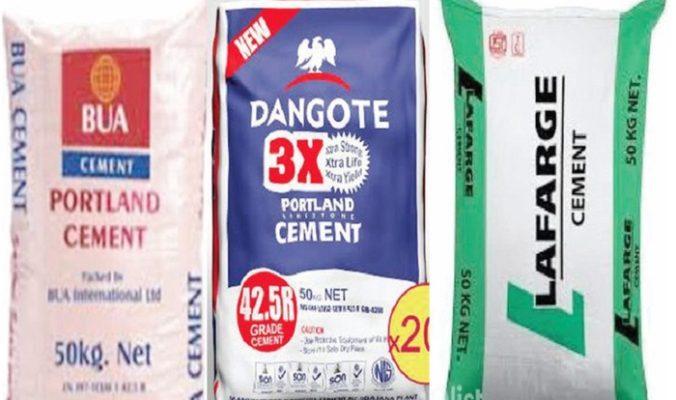
The development also coincided with strong financial performances by major players in the sector. Dangote Cement Plc, BUA Cement Plc and HBM Nigeria Plc, formerly Lafarge Cement, reportedly posted combined revenues of about N3.2 trillion in the first half of 2026.
A group of built-environment experts blamed part of the problem on market concentration, arguing that the dominance of a few major producers could weaken competition and limit the ability of market forces to moderate prices.
The experts urged the government to create an enabling environment for credible new cement producers to enter the market while encouraging existing manufacturers to expand their operations.
They also advocated regular disclosure of production volumes, capacity utilisation and recommended distributor prices, subject to existing competition laws.
Industry experts who examined the cement production process also argued that prevailing production costs did not appear to justify the current retail price.
According to industry expert Kelvin Tar, production involves the extraction and crushing of limestone, clay, shale and sand, followed by proportioning, blending and grinding into raw material.
The material is subsequently heated in preheater towers before being processed in rotary kilns at temperatures of up to 1,450 degrees Celsius to produce clinker. The clinker is then cooled, mixed with gypsum and ground into the final cement product.
Another expert, Clement Joseph, estimated that extraction and crushing could cost about N500 per bag, while proportioning, blending and raw grinding could amount to approximately N950.
He put the cost of pyroprocessing, described as the most expensive stage, at about N3,500 per bag, while finish grinding could cost about N1,200.
Packaging, storage and logistics were estimated at another N1,500 per bag.
Based on these calculations, Joseph estimated that a fair factory-gate price should fall between N7,000 and N8,000 per 50kg bag, allowing manufacturers a profit margin of roughly 20 to 25 per cent.
Nya-Etok warned that the impact of expensive cement extended far beyond individual home builders. He said rising cement prices inevitably pushed up house prices, increased the cost of government construction projects and contributed to the abandonment of building projects.
He further warned that prolonged high prices could encourage some builders to cut corners by reducing cement content or resorting to unsuitable alternatives, potentially compromising the quality and safety of buildings.
“Cement affordability is not merely an economic matter. It is a housing, infrastructure and potentially building-safety matter,” he said.
He therefore called for a national dialogue on cement pricing involving manufacturers, distributors, regulators, government agencies, legislators, developers, built-environment professionals, economists, consumer groups, labour and civil society organisations.
The proposed engagement, he said, should establish how the current N15,000 retail price is determined and identify what a fair and competitive price should be.
He also advocated a comparative study of cement prices across African countries to determine whether Nigerian consumers are paying disproportionately higher prices for the commodity.